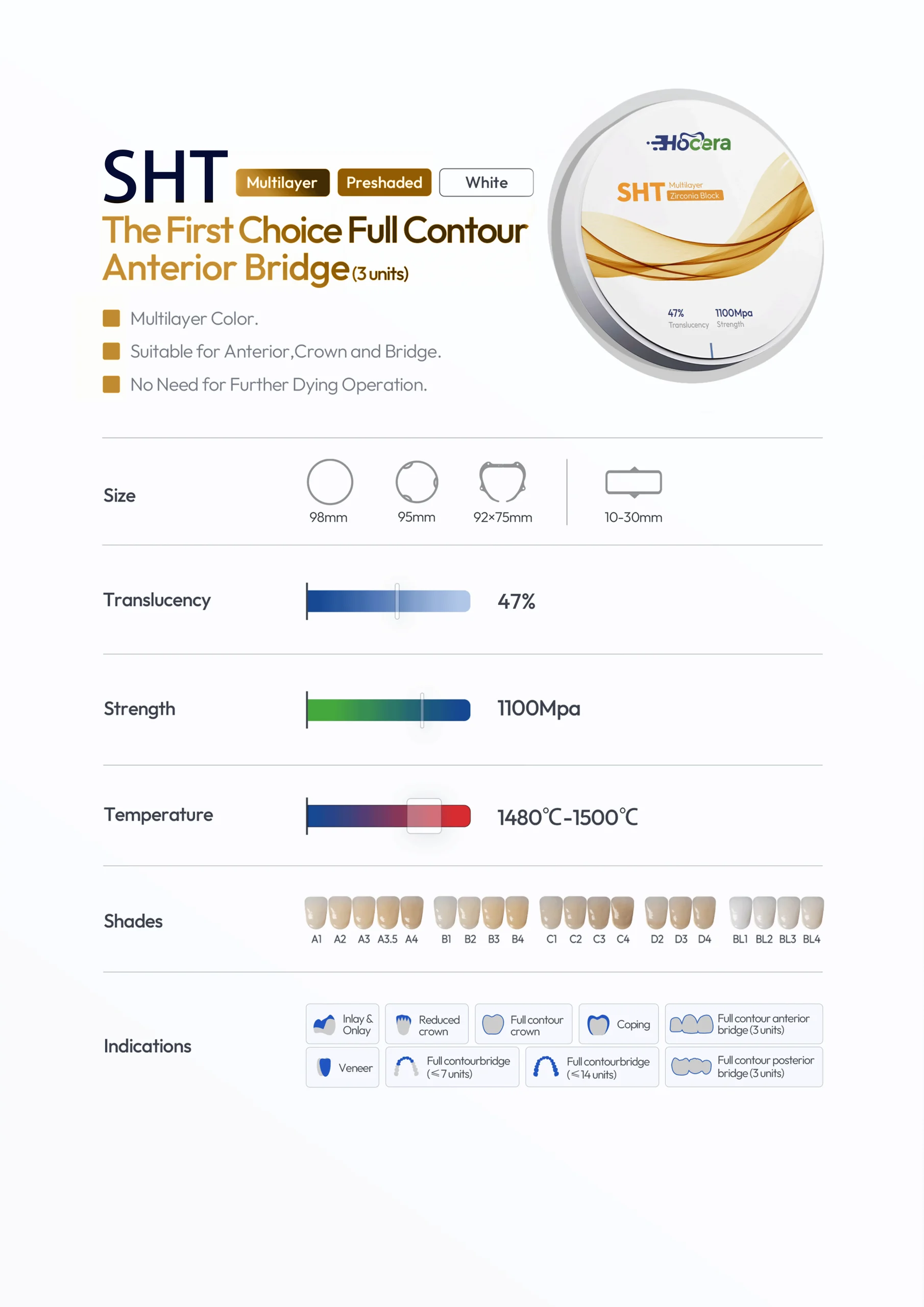
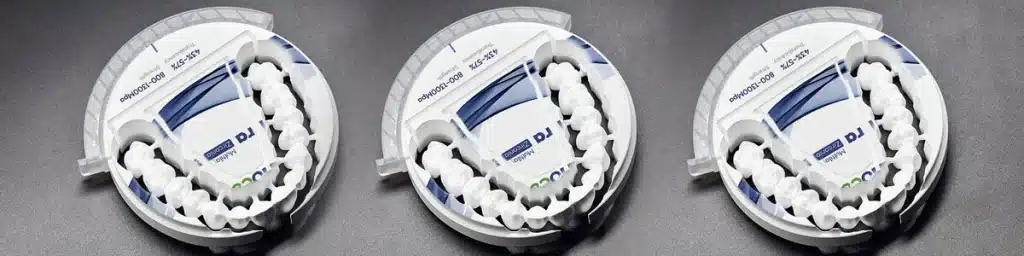
Hocera SHT Multilayer Zirconia Disc
Balanced Aesthetics and Strength for Daily Clinical Indications
Hocera SHT Multilayer Zirconia Disc is developed for dental laboratories seeking a reliable balance between esthetic performance and mechanical strength across anterior and posterior indications.
By combining a controlled translucency gradient with stable 4Y-TZP zirconia chemistry, this material supports predictable CAD/CAM workflows without relying on excessive post-staining or complex layering techniques.
As a result, laboratories can achieve consistent shade reproduction, controlled masking ability, and dependable structural performance within commonly accepted clinical design parameters.
Clinical Applications and Indications
Anterior Crowns
For anterior restorations, optical performance plays a decisive role. Therefore, Hocera SHT zirconia integrates a gradual translucency transition from cervical to incisal areas.
-
Incisal translucency up to approximately 46%, measured under standardized light transmission testing
-
Pre-integrated VITA A1–D4 shade gradient for natural color continuity
According to internal esthetic evaluations (n=120), restorations fabricated with this disc demonstrated a high visual match to adjacent natural dentition when standard preparation guidelines were followed.
Posterior Crowns
In posterior regions, mechanical reliability remains the primary concern. Consequently, Hocera SHT zirconia provides:
-
Flexural strength of approximately 1100 MPa, tested in accordance with ISO 6872:2015
-
Stable marginal integrity down to 0.3 mm, when appropriate milling and sintering protocols are applied
These properties allow laboratories to fabricate posterior crowns with predictable performance under normal occlusal loads.
Veneers
For minimally invasive indications, material behavior at reduced thickness is critical.
-
Minimum recommended thickness: 0.4 mm
-
Controlled opacity gradient helps reduce the visual influence of mildly discolored substrates
Clinical follow-up data indicates stable retention and esthetic performance when proper bonding protocols are respected.
3-Unit Bridges
Hocera SHT zirconia is suitable for short-span fixed dental prostheses, particularly 3-unit bridges within conventional indications.
-
Connector cross-section ≥ 9 mm², following standard laboratory design recommendations
-
Uniform stress distribution validated through laboratory fatigue testing (1.2 million cycles, ISO-based methodology)
These parameters support safe and predictable framework fabrication without over-contouring connectors.
Material Science and Optical Design
Hocera SHT zirconia is based on advanced 4Y-TZP zirconia, engineered to balance translucency and strength rather than maximizing either parameter alone.
-
Multilayer structure with controlled chromatic and translucency transition
-
Fine-grain zirconia microstructure enhances edge stability and polishability
-
Certified according to ISO 13356 and ISO 6872, ensuring suitability for dental applications
Importantly, the multilayer fusion process minimizes visible layer demarcation after sintering, which improves esthetic consistency across batches.
Workflow and Laboratory Advantages
From a laboratory perspective, efficiency and reproducibility are equally important.
Therefore, Hocera SHT zirconia offers:
-
Stain-free workflow, reducing manual finishing time per unit
-
Smooth milling behavior with reduced chipping risk
-
Dimensional stability during sintering, with shrinkage deviation typically within ±0.3%, under validated sintering conditions
These characteristics contribute to higher first-fit rates and fewer remakes in digital production environments.
Clinical Positioning Summary
Hocera SHT Multilayer Zirconia Disc is designed for everyday restorative dentistry, where laboratories require controlled esthetics, sufficient strength, and stable processing behavior.
Rather than targeting extreme indications, this material focuses on predictability, consistency, and efficiency, aligning with modern digital laboratory workflows and clinical expectations.