For True-to-Life Anterior Restorations
In high-esthetic anterior restorations, optical behavior matters as much as strength. Hocera 3D Multilayer Pro Zirconia is engineered to replicate the visual depth, translucency, and color transition of natural teeth.
Rather than relying on surface staining, this multilayer zirconia achieves realism through material-level gradient design. As a result, restorations appear natural under both clinical lighting and daylight conditions.
Exceptional Aesthetics Through Controlled Translucency
Unlike conventional zirconia blocks with uniform translucency, Hocera 3D Multilayer Pro features a gradual translucency transition from incisal to cervical.
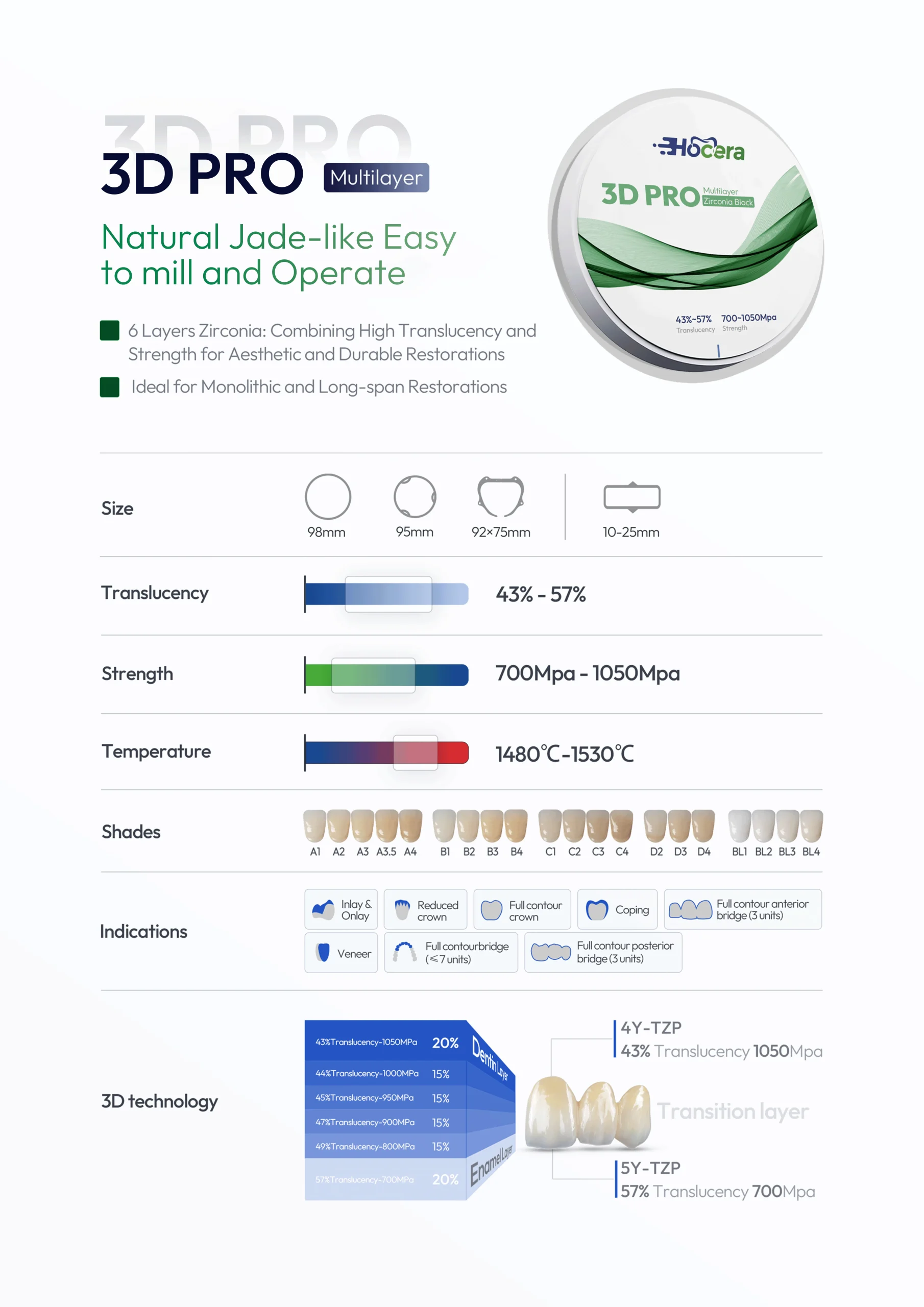
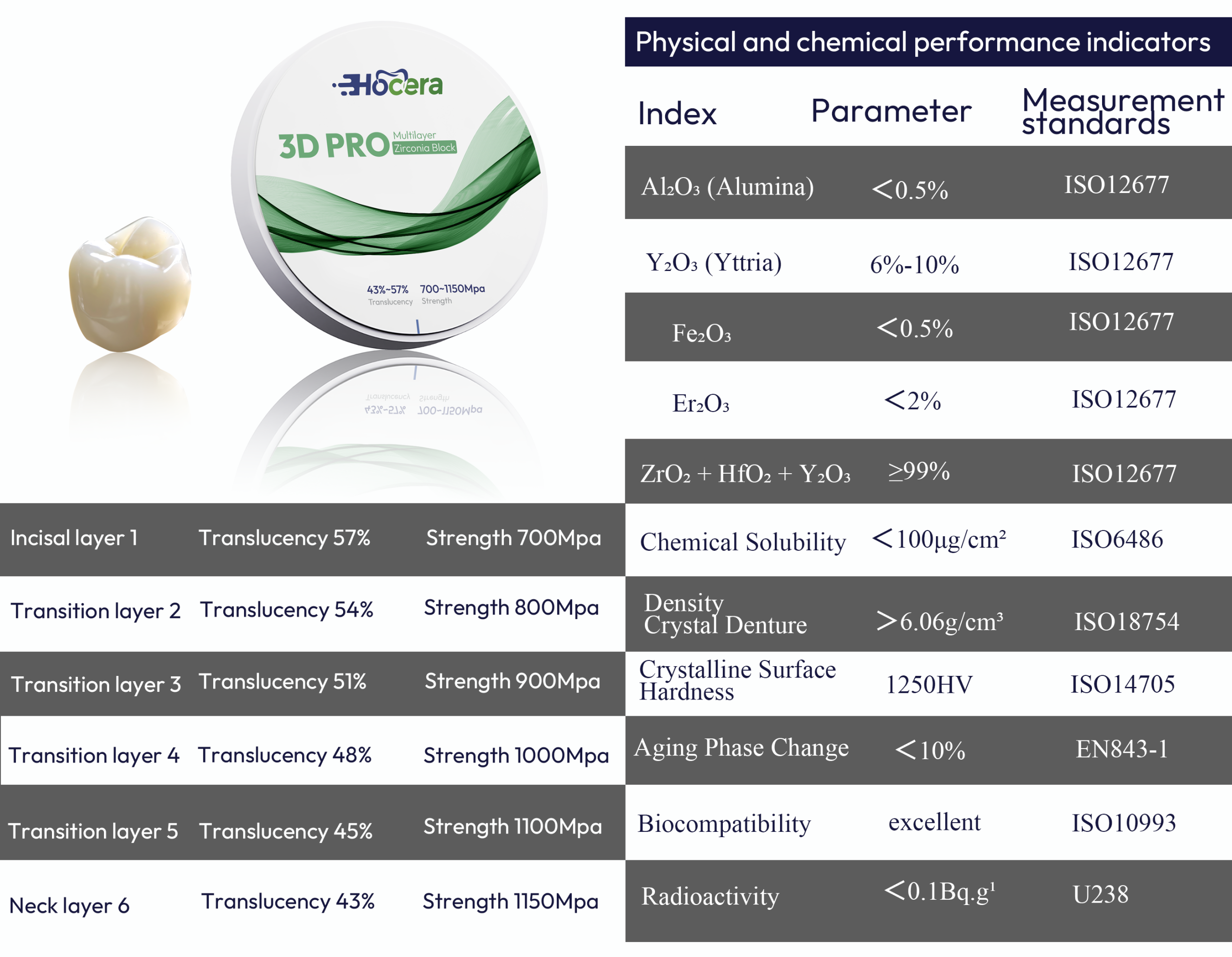
Specifically, translucency ranges from 57% at the incisal edge to 43% at the cervical zone. Therefore, the incisal area closely mimics natural enamel transparency. Meanwhile, the cervical region provides sufficient opacity to mask underlying tooth structure or implant abutments.
As a result, restorations demonstrate depth, vitality, and realistic light behavior without over-whitening or greying effects.
Seamless Multi-Layer Structure for Natural Color Flow
To achieve a smooth visual transition, Hocera applies a 6-layer structural design combined with 11 gradient color layers. This configuration allows color and translucency to shift progressively from cervical to incisal zones.
Consequently, the color distribution appears continuous rather than segmented. In practice, this eliminates abrupt transitions that are often visible in lower-grade multilayer zirconia.
Moreover, the pre-layered structure significantly reduces or eliminates the need for external staining. As a result, laboratories can achieve consistent shade outcomes while saving finishing time.
Strength Gradient Designed for Clinical Reality
Aesthetic performance alone is not sufficient for long-term success. Therefore, Hocera 3D Multilayer Pro incorporates a mechanical strength gradient that aligns with functional demands.
-
Incisal zone: optimized for translucency and esthetics
-
Cervical zone: reinforced for load-bearing stability
Flexural strength gradually increases from approximately 700 MPa to 1050 MPa, depending on position within the disc. As a result, the material supports both esthetic anterior crowns and functional bridges.
This balance allows laboratories to use a single zirconia solution for anterior crowns, posterior crowns, and multi-unit bridges.
Optimized for Precision Milling and Stable Sintering
From a laboratory workflow perspective, Hocera 3D Multilayer Pro is engineered for predictable CAD/CAM processing.
The material demonstrates excellent milling behavior with clean margins and low tool wear. Therefore, chipping risk during milling is minimized.
After sintering, the zirconia achieves a sintered density of 6.07 ± 0.01 g/cm³, indicating a dense and stable microstructure. In addition, hardness reaches approximately 1250 HV, supporting long-term wear resistance.
Recommended sintering temperature ranges from 1480°C to 1530°C, allowing compatibility with standard and fast sintering programs.
Indications and Clinical Versatility
Because of its combined esthetic and mechanical properties, Hocera 3D Multilayer Pro is suitable for a wide range of indications:
-
Anterior veneers and crowns
-
Posterior crowns
-
Multi-unit bridges
-
Full-contour restorations
-
Implant-supported prosthetics
Furthermore, compatibility with open-system CAD/CAM milling machines and common disc sizes (95 mm, 98 mm) simplifies integration into existing laboratory workflows.
Why Laboratories Choose Hocera 3D Multilayer Pro
Ultimately, Hocera 3D Multilayer Pro is designed for laboratories that demand aesthetic realism without compromising strength.
By combining translucency gradient, color layering, and strength zoning within a single disc, it reduces manual steps, lowers remake rates, and improves first-fit success.
As a result, dental laboratories can deliver predictable, lifelike restorations efficiently—even in high-volume or high-esthetic cases.
High strength meets lifelike aesthetics.
Precision milling with near-zero chipping.
A reliable solution from monolithic crowns to full-arch bridges.