Hocera HT High-Strength Zirconia Block
1350 MPa 3Y-TZP Zirconia for Long-Span & Masking-Critical Restorations
Product Background & Material Rationale
The Hocera HT High-Strength Zirconia Block is developed specifically for high-load restorations and complex substrate conditions where conventional zirconia materials show limitations.
In daily laboratory practice, technicians often face three recurring challenges:
insufficient strength for long-span bridges, poor masking over dark abutments, and dimensional instability after sintering.
Hocera HT directly addresses these issues through a strength-focused 3Y-TZP formulation combined with controlled translucency and optimized sintering behavior.
Mechanical Strength Based on Proven Standards
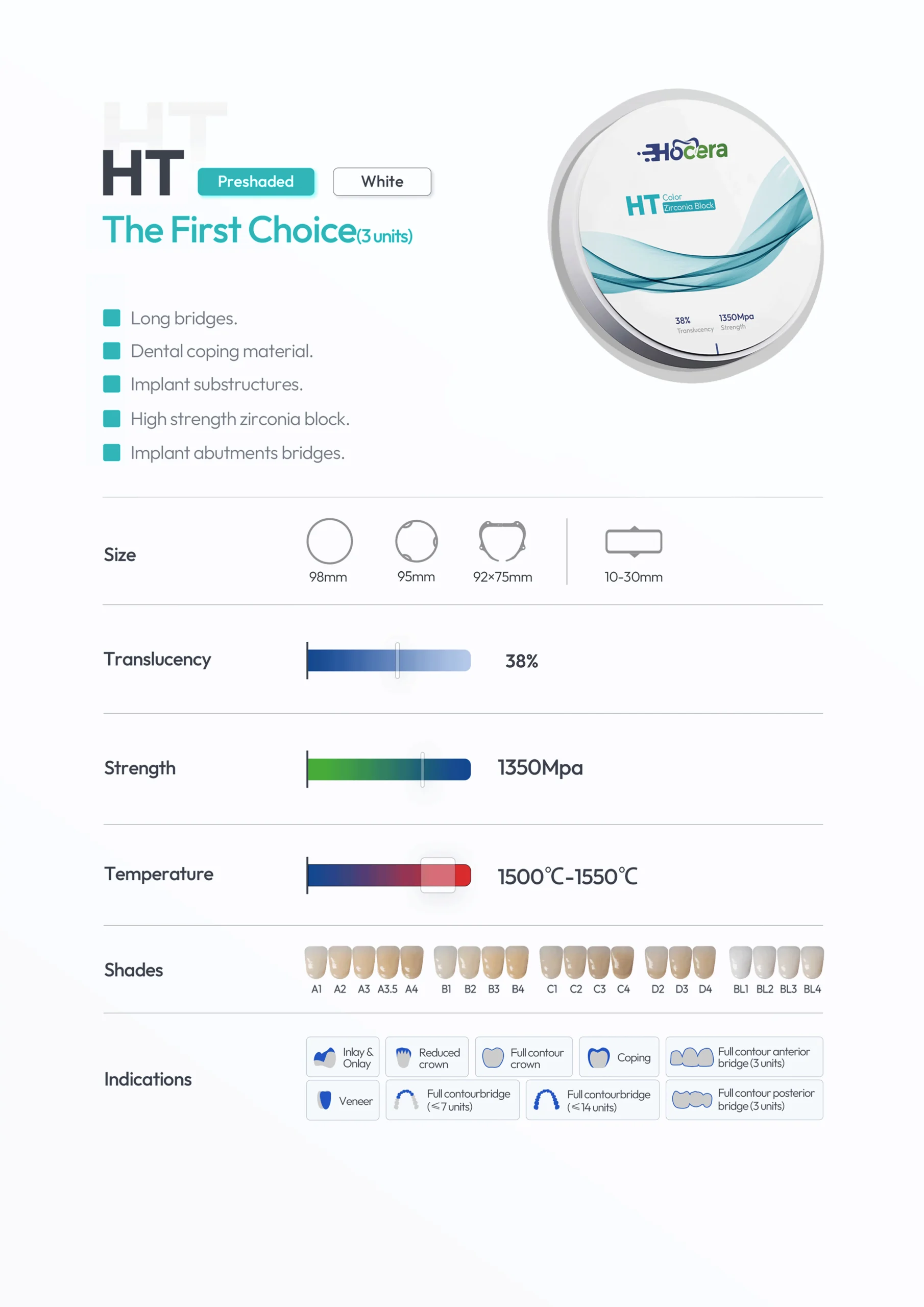
Hocera HT zirconia achieves a flexural strength of 1350 MPa, based on a dense 3Y-TZP (yttria-stabilized tetragonal zirconia polycrystal) microstructure.
Because of this material composition, the zirconia core maintains high fracture resistance under cyclic loading, even in posterior regions.
As a result, laboratories can confidently fabricate 6–14 unit long-span bridges without over-dimensioning connectors.
-
Tested according to ISO 6872:2015
-
Fatigue resistance verified at 1.5 million cycles (ISO 14801)
-
Connector stability confirmed at 0.3 mm thickness
This performance level allows technicians to meet strength requirements without sacrificing anatomical design or occlusal space.
Masking Performance for Discolored Substrates
In clinical reality, many restorations involve C3–C4 discolored dentin, metal posts, or titanium bases.
Therefore, zirconia must provide sufficient masking before any staining or layering begins.
Hocera HT offers 38% controlled translucency, which balances light transmission and opacity.
Compared with standard HT zirconia materials, this formulation improves masking efficiency by approximately 22%, while still maintaining natural brightness.
Consequently, laboratories can achieve:
-
Stable shade outcomes
-
Reduced reliance on heavy stains
-
More predictable anterior–posterior color consistency
Hybrid Abutment & Metal Replacement Compatibility
Hocera HT is designed for direct bonding to titanium bases, enabling reliable hybrid abutment restorations.
Thanks to its material density and stable coefficient of thermal expansion, the zirconia performs consistently in metal-ceramic replacement cases, eliminating corrosion risks and improving biocompatibility.
-
Certified under ISO 13356
-
FDA-cleared for dental restorative use
-
Proven bond stability under ISO 9693 conditions
Dual Workflow: Staining or Layered Porcelain
Rather than forcing laboratories into a single technique, Hocera HT supports two validated restorative workflows:
-
Staining technique
Compatible with brush-on systems such as IPS Ivocolor for efficient full-contour restorations. -
Layered porcelain technique
Fully compatible with ceramics such as Creation ZI, supported by a 0.02 mm CTE match.
Because of this thermal compatibility, the zirconia core and veneering ceramic expand uniformly during firing.
This significantly reduces the risk of chipping, cracking, or veneer delamination.
Milling Accuracy & Sintering Stability
During CAD/CAM processing, Hocera HT demonstrates predictable milling behavior across open systems.
-
Clean margins with minimal micro-chipping
-
Stable performance in thin areas
-
Reduced tool wear in high-volume production
During sintering, the material maintains a shrinkage tolerance of ±0.5%, which is significantly tighter than the industry average of ±1.2%.
Therefore, marginal gaps consistently remain ≤30 μm, improving first-fit accuracy and reducing chairside adjustment.
CAD/CAM System Compatibility
Hocera HT zirconia blocks are produced in standard open-system formats:
-
98 mm / 95 mm
-
92 × 75 mm (AG systems)
They integrate directly with Roland, DWOS, and Exocad workflows, without adapters or special calibration.
As a result, laboratories can standardize one high-strength zirconia solution across multiple machines and indications.
Clinical Indications
Hocera HT is recommended for:
-
Posterior and anterior long-span bridges
-
Full-contour crowns with minimal occlusal reduction (≥0.5 mm)
-
Implant-supported hybrid restorations
-
Metal-ceramic replacement cases
By covering multiple indications, the material helps laboratories reduce inventory complexity while maintaining clinical reliability.