Introduction
White zirconia has become one of the most widely used materials in modern dentistry due to its strength, esthetics, and reliability. Among its many properties, hardness is one of the most critical factors. At Hocera, we are often asked: “How hard is white zirconia compared to enamel, porcelain, or lithium disilicate?”
This article explains the hardness of white zirconia, how it is measured, and why it matters for dental restorations and clinical applications.
Understanding Hardness
Hardness refers to a material’s resistance to localized deformation such as scratching or indentation. The three most common measurement methods are:
- Mohs scale: Ranks minerals from 1 (softest) to 10 (hardest).
- Vickers hardness (HV): Measures indentation resistance with a diamond pyramid; more accurate for ceramics.
- Rockwell hardness: Widely used in metals, less common for dental ceramics.
For dental zirconia, the Vickers hardness scale is the most relevant and reliable.
Hardness of White Zirconia
- Mohs scale: ~ 8–8.5. This places zirconia close to topaz and well above natural enamel.
- Vickers hardness (HV): Typically 1200–1450 HV, depending on the grade (3Y, 4Y, 5Y) and sintering conditions.
For comparison:
- Natural enamel: ~270–370 HV
- Lithium disilicate: ~580–700 HV
- Feldspathic porcelain: ~460–600 HV
This shows why zirconia is considered the hardest and most wear-resistant material in dentistry.
Why Hardness Matters in Dentistry
The exceptional hardness of white zirconia provides several clinical benefits:
- Durability: Zirconia crowns and bridges resist fracture and wear, ensuring long-term performance.
- Resistance to abrasion: Properly polished zirconia is less abrasive to opposing enamel than rough porcelain.
- Stability under chewing forces: Zirconia restorations maintain shape and surface integrity under daily function.
- Combination with porcelain: A zirconia core provides strength, while porcelain veneers deliver natural esthetics.
Practical Considerations
- Surface finish matters: A polished zirconia surface is more enamel-friendly than a rough or glazed one.
- Maintenance: After occlusal adjustments, zirconia restorations should be re-polished to maintain smoothness.
- Processing factors: Yttria content, sintering temperature, and grain size can slightly influence hardness.
Applications Beyond Dentistry
- Industry: Bearings, cutting tools, and wear-resistant components.
- Jewelry: As a diamond substitute, zirconia offers durability and brilliance.
Hocera’s Advantage
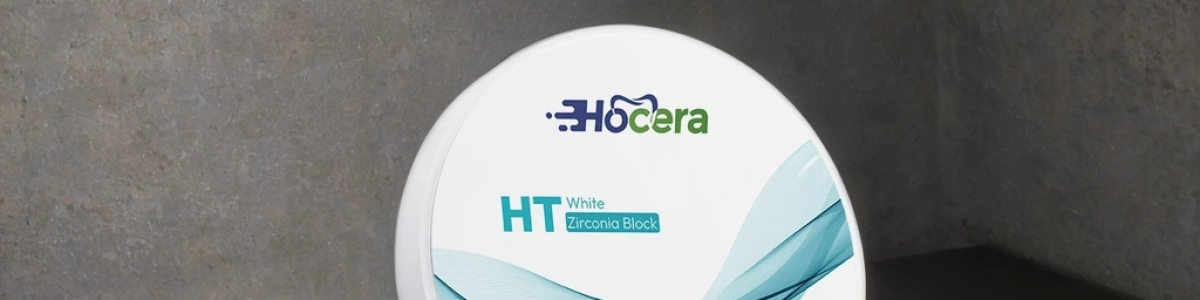
At Hocera, we supply premium Zirconia Dental Blocks and 1350 MPa zirconia materials designed to achieve the perfect balance of hardness, translucency, and clinical safety. Our products undergo strict hardness testing (Vickers scale) to ensure consistency and reliability.
For dental labs and clinicians seeking zirconia with proven performance, Hocera provides a full portfolio tailored to your needs.
Conclusion
White zirconia demonstrates a Mohs hardness of 8–8.5 and a Vickers hardness of around 1200–1450 HV. This high hardness explains why it is one of the most durable and reliable materials for dental crowns, bridges, and implants.
When polished correctly, zirconia not only delivers longevity but also protects opposing enamel better than many traditional ceramics.
Hocera remains committed to supplying dental professionals with high-quality zirconia solutions that combine strength, esthetics, and clinical safety.
References
- Tosoh 3Y-TZP Technical Data: HV10 ≈ 1250
- Dejak et al., Materials 2024: Dental zirconia ≈ 1450 HV1; enamel ≈ 372 HV1
- PMC Review 2025: Polished zirconia hardness ~1240–1320 HV
- Enamel hardness study: ~275 HV
- Lithium disilicate hardness: ~580–700 HV