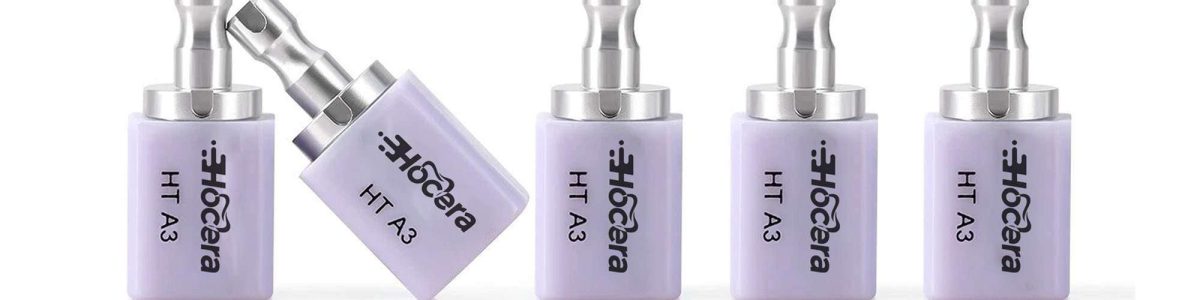
Lithium disilicate (LS₂) glass-ceramics earned their place in modern dentistry because they combine esthetics with real strength. But those properties don’t “just happen”—they’re unlocked by a specific phase transformation during firing. Below we explain, in plain lab language, what’s changing inside the block, why it matters, and how you can dial-in consistent results with Hocera C14 Lithium Disilicate CAD/CAM Blocks.
The Short Version (for busy technicians)
- CAD/CAM “blue-stage” blocks are lithium metasilicate (Li₂SiO₃) in a glassy matrix—easy to mill but relatively weak.
- Crystallization firing converts them to lithium disilicate (Li₂Si₂O₅) with an interlocking, needle-like microstructure—much stronger and tougher.
- Typical cycles: ~840–870 °C for ~10–20 min, depending on furnace and block—follow your IFU. During this step, the crown also reaches its final shade/translucency. PMCivoclar.com+1
Step-by-Step: What Actually Transforms?
1) Nucleation (lower temps)
On heating from the glassy state, small crystal nuclei form (helped by nucleating agents like P₂O₅ ± ZrO₂, depending on the formulation). These seeds set up fast, uniform growth later. e-space.mmu.ac.uk
2) Growth to lithium disilicate (crystallization firing)
At higher temperatures (commonly ~840–850 °C in many CAD cycles), lithium metasilicate transforms and grows into lithium disilicate. The resulting interlocking, elongated (needle/whisker-like) Li₂Si₂O₅ crystals pack the glassy matrix and deflect/bridge cracks—this is the backbone of LS₂ strength and clinical durability. PMCFrontiers
✅ Important correction to a common myth: In dentistry we don’t go “monoclinic → orthorhombic.” The key transformation is phase: lithium metasilicate → lithium disilicate during crystallization. That change, together with crystal size/volume fraction, drives the jump in strength and the final optical look. PMC
3) Final properties after firing
After crystallization, LS₂ restorations reach their rated mechanical values; e.g., commercial CAD blocks report ~360–530 MPa biaxial flexural strength after crystallization (blue stage is ~130 MPa—great for milling, not for the mouth). Exact values depend on brand, furnace, and cycle. ivoclar.com
Why This Matters in the Lab
- Strength & toughness: Interlocking Li₂Si₂O₅ needles raise flexural strength and fracture toughness (crack deflection/bridging). Frontiers
- Optics: Crystal size, aspect ratio, and volume fraction tune translucency. Proper cycles keep crystals fine enough for esthetics while still reinforcing the glass matrix. e-space.mmu.ac.uk
- Process reliability: Uniform nucleation/growth means predictable margins, contacts, and shades—less rework. PMC
Practical Firing Guidance (follow your IFU first)
| Stage | Typical Range (indicative) | What’s happening |
|---|---|---|
| Preheat / Dry | per furnace | Removes moisture; stabilizes ramp |
| Nucleation | ~450–550 °C (varies) | Seed formation in the glass |
| Crystallization | ~840–870 °C for ~10–20 min | Metasilicate → disilicate; shade & translucency finalize |
| Cool | Controlled | Avoid thermal shock; stabilize shade |
Notes: Exact hold times/ramps differ by furnace model and block design. Some modern furnaces complete full crystallization in ~11 min with validated cycles. Always prioritize your block’s IFU and furnace recommendations. ivoclar.com
Troubleshooting Fast
- Milky/over-opaque: Over-growth (too hot/too long) → coarser crystals. Re-check cycle and loading (avoid crowding trays). e-space.mmu.ac.uk
- Weak chips post-try-in: Under-crystallized (too cool/too short) or contaminated surface. Verify peak/hold; avoid saliva/oil before firing. ivoclar.com
- Hue off vs. tab: Firing schedule mismatch, furnace calibration, or incorrect foil/holder. Re-calibrate; run a shade chip with the exact cycle. ivoclar.com
Why Hocera C14 Lithium Disilicate Blocks
- Consistent crystallization window for reliable shade/strength across furnaces
- Fine, interlocking LS₂ microstructure designed for high polish and lifelike translucency
- Smooth blue-stage milling with clean margins and minimal bur wear
Looking for zirconia instead? See Hocera Multilayer Zirconia for posterior load cases.
References (for E-E-A-T and accuracy)
- CAD/CAM LS₂ crystallization ranges and phase evolution; clinical context. PMC+1
- Blue-stage vs. post-crystallization strength and cycle examples. ivoclar.com+1
- Role of nucleating agents and temperature windows in LSCs. e-space.mmu.ac.uk
- Microstructure–mechanics link (interlocking needles, crack deflection/bridging). Frontiers
- Crystal system notes for metasilicate (orthorhombic).